
UoB Guild Elections: The Wrong Politics
Eli Laifer on radical politics, campus slogans, and the Guild election that says it all.
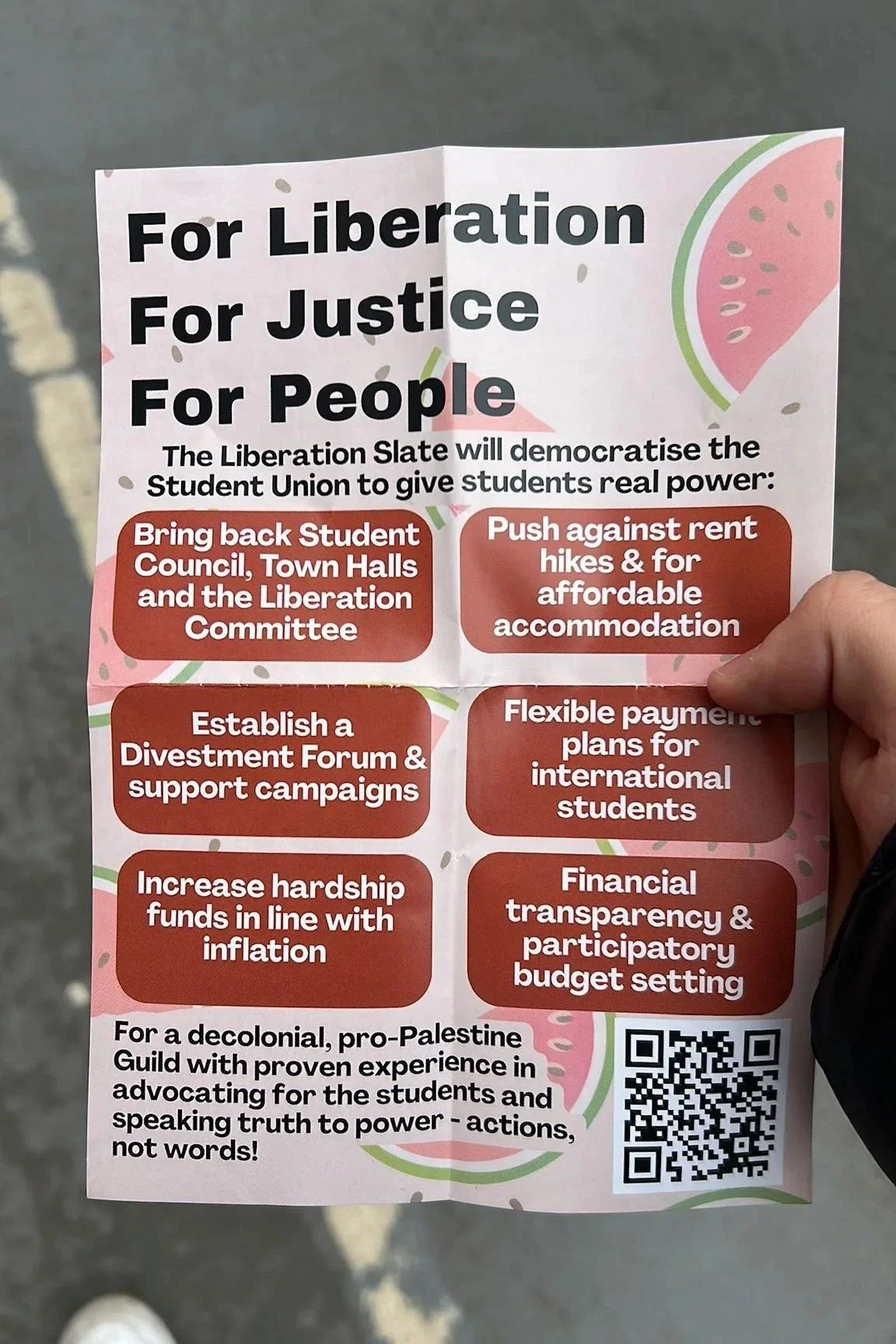
This morning, I was pulled out of bed at the early hour of 11 a.m. to join a friend on campus to inspect the Student Union campaigners scattered across the cobbled streets of the University of Birmingham. I am not one to turn down a side quest, so I went along for the adventure. Little did I know that I was about to walk straight into my worst political nightmare.
As I approached campus, the concentration of keffiyehs began to increase. At first there was one or two, then a few more, and then suddenly it seemed that over half the people out in public were dressed in full costume, enthusiastically playing the part of the ignorant “Student for Palestine”.
I quickly became both excited and slightly terrified. I had stumbled across an entire field of unicorns.
My friend and I wandered over and listened as the freedom fighters delivered their campaign pitches from a safe observational distance.
“Push against rent hikes and for affordable accommodation.”
Hell yeah.
“Increase hardship funds in line with inflation.”
Cool.
“Bring back Student Council and the Liberation Committee.”
Aweso… wait. Liberation Committee?
Of course, they were referring to the encampments you may remember from 2023 to 2024 that filled the green spaces of the Vale, the main campus, and almost every patch of grass Birmingham could spare. These were the same encampments that, following October 7, helped cultivate an atmosphere of fear, harassment, and hostility for Jewish students navigating their university experience.
And, as many people will also remember, they did not exactly appear in a financial vacuum, with questions raised at the time about the flow of funding from places such as Iran and Qatar.
By this point, if the enormous gold keffiyehs hanging around their necks had not already given the game away, their political identity certainly had. The Liberation Slate.
I spoke to one of their candidates, Nyamesumpa Abbey, who is campaigning for Welfare and Community Officer. On a personal level, she was cheerful, confident, and clearly very comfortable explaining her platform. I genuinely enjoyed the conversation, if only because the reasoning behind some of it was so spectacularly baffling.
At one point, I asked what I thought was a fairly simple question:
“So, what are your thoughts on campus security? How can we make students feel safer than they might feel now?”
She responded that security has too much power on campus and that it makes students feel uncomfortable as they go about their day.
I pushed back, suggesting that we probably need more security rather than less, particularly given the number of incidents of assault and harassment that occur on and around campus.
“More security?” she replied.
“I don’t feel there’s a problem with security.”
Said the axe to the tree.
Biting my tongue to avoid dropping the J-word, I gave a few examples of assault and harassment that people I know have experienced over the past few years. Incidents that, when I first considered coming to Birmingham, made me nervous about what I might be walking into.
“I think there’s an emergency call button on the Vale,” she responded helpfully.
Standing there this morning, I realised something. It was not the possibility of violence that felt most unsettling. It was the sheer confidence of people who insist there is no problem at all.
While this issue has intensified dramatically since October 7, it is certainly not a new one. In a particularly interesting episode of the podcast Ask Haviv Anything, historian Izabella Tabarovsky notes that “students holding signs saying ‘Zionism is racism’ looked exactly like Soviet messaging”.
Tabarovsky, a Soviet-born writer and activist, explains that when she saw these slogans at Western demonstrations, she recognised them immediately as language drawn directly from Soviet propaganda campaigns. During the Cold War, Zionism was framed by the USSR as aligned with American ideology. Because the Soviet leadership believed the United States had supported Israel during the 1967 war, Zionism was portrayed as a colonial and racist project, and therefore an enemy of the Soviet state. That framing spread widely through political movements and academic spaces, and decades later its language still echoes in parts of modern activist culture.
This is one reason why many far-left students on campus feel such a strong ideological connection to the Palestinian cause. Within that inherited framework, Zionism is treated not as a national movement, but as the political opponent of the liberation these movements claim to represent.
I could easily have spent five hours with Ms Abbey that morning. I would have asked her views on the United Arab Emirates’ recent warning about students studying abroad in the United Kingdom due to concerns about radicalisation. I would have asked how camping on the lawn of a university 2,300 miles away from Gaza meaningfully advances the Palestinian cause. And I would have asked why Palestinian activism has become such a central focus of the Student Union in the first place.
When all is said and done, I would hope most students care more about their grades being marked properly than whether a country an ocean away is facing accusations of “genocide”. And if international justice is truly the priority, one might reasonably ask where the comparable outcry is for Iran, Ukraine, Sudan, China, or North Korea.
If you are a student at Birmingham, do yourself a favour and vote in the next election. The Liberation Slate represents everything wrong with the radicalisation creeping into student politics in this country. It is about time that university returned to what it has always been meant to prioritise above all else, education.
