
This year’s editor, Anya, considers the purpose of discomfort, the value of questioning and the responsibility that comes with advocacy.
For one week every year, Judaism asks us to leave our perfectly functional houses and sit in a hut. Often, it’s not the most convenient; you’re shivering and drops of rain plummet through the shabby roof. You may have gone numb from sitting too long on the plastic chair that’s been dusted off from the shed for this very purpose while accidentally treading on the decorations which have flopped off the sides. Yet, somehow, we’re supposed to be happy about it.
Why?
The obvious answer would be that it is a mitzvah. But Judaism isn’t exactly known for being short of easy ways to fulfil a commandment.
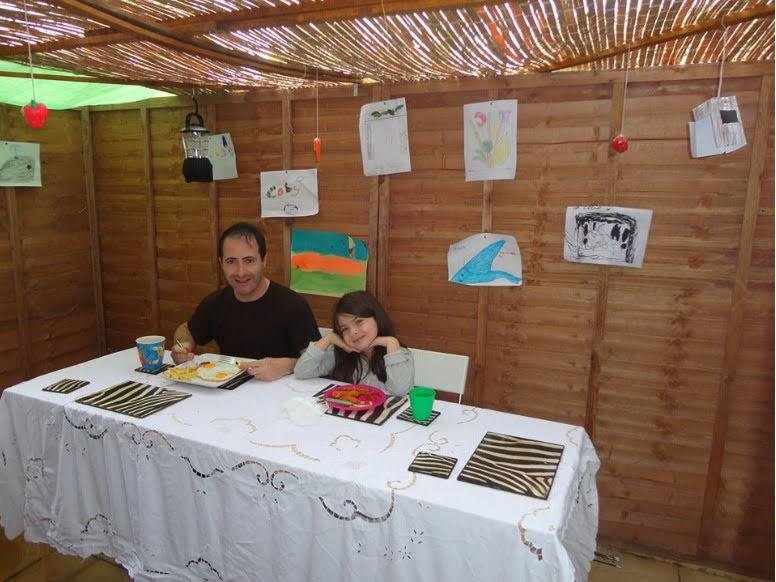
We could stay inside. We could eat at the dining table. We could sleep cosily in our beds. We could even shake a lemon in the air. Instead, for seven days, we are asked to step outside of the comfort and security of our four-walled, insulated homes.
There is something deliberate about making ourselves uncomfortable…And Sukkot isn’t the only time Judaism does this.
We are repeatedly asked to do things that are uncomfortable, inconvenient or challenging. On Pesach, we remember slavery rather than simply celebrate our freedom, from leaning while drinking wine to swallowing the tears of our ancestors in the form of salt water. On Yom Kippur, we deliberately don’t eat or drink for 25 hours and wear white to be like angels (risky for stains). On Tisha B’Av, we remember destruction and tragedy. On Shabbat, we stop working, even when we have things we want to get done. Maybe Judaism doesn’t see comfort as the ultimate goal.
Perhaps our discomfort is the point. We can’t appreciate the good without experiencing the bad. With this uneasiness, we’re forced to notice things. When everything is comfortable, we stop thinking about it. We become complacent.
We don’t wake up thinking:
“Wow, I’m incredibly lucky to have a roof over my head.”
We just have one.
Then, suddenly, you’re sitting underneath a slab of wood and fabric while the heavens are chucking buckets of rain down, and you’re very aware of your roof (or lack thereof).
So Sukkot makes something ordinary feel extraordinary. Discomfort creates gratitude.
Yet, it doesn’t stop there; it also makes us question what we think we know, asking us to become comfortable with being intellectually uncomfortable.
We are encouraged to question, to argue, to challenge and to sit with ideas that don't have easy answers. Jewish tradition is full of debate. However, it is far easier to believe we are correct than sit with the possibility that we might be wrong.
In modern life, we are constantly surrounded by algorithms which show us things we already agree with. Social media creates pockets where our opinions are constantly reinforced and it can become surprisingly easy to go through life without ever having to seriously engage with an opposing viewpoint. Judaism doesn’t want us to become lackadaisical, we’re asked to do the reverse.
This is something particularly important in Jewish spaces. It can be tempting to surround ourselves with people who think exactly like us, particularly in conversations around Israel, Zionism and Jewish identity. But ideological discussion only means something if we are willing to encounter ideas that challenge us. For how can you know what you believe is true if there’s nothing to oppose it? That is what makes discomfort so valuable. Being comfortable doesn’t require us to question anything; we can stay exactly where we are, surrounded by people who agree with us and ideas that confirm what we already believe. Discomfort interrupts that. It makes us curious.
Going to Israel means taking a leap outside of the version of the country that exists in our heads. You encounter a place more complicated, contradictory and more ordinary than a postcard, headline or social media post can ever capture. And that is what makes it extraordinary. It is a society that doesn’t operate like Britain, where you hear Hebrew spoken around you, encounter a completely different cultural environment and see religious and secular Jews living alongside one another. You encounter political disagreements that can feel much more immediate, and the reality of living in a country where security concerns are part of everyday life. You meet communities and people whose experiences can be completely different from your own, and you are forced to confront questions about Zionism and Jewish identity that might feel much more abstract from thousands of miles away. My experience as a StandWithUs Emerson Fellow has made me particularly aware of the importance of engaging with these complexities. Advocacy requires us not only to know what we believe, but to understand the questions and challenges surrounding it.
You might encounter things that confirm what you already believe. You might encounter things that challenge it. You might find yourself asking questions you hadn’t thought to ask before. And that can be uncomfortable. But you don’t have to agree with everything you encounter for it to be valuable. We shouldn’t need Israel, Judaism or Zionism to be simple in order to care about them. We can love a place and still question it. We can feel connected to an idea and still examine it. We can disagree with someone without deciding that there is nothing we can learn from them.
Sukkot asks us to leave the place where we feel most secure. In some ways, that is part of what Israel can do too - taking us out of familiar environments and placing us somewhere where our assumptions can be challenged.
For many British Jews, Israel can feel simultaneously familiar and unfamiliar. It can be somewhere we have strong emotional connections to, without necessarily understanding every part of it. That is the Jewish art of being uncomfortable.
