
A Jewish Night in London
Movement worker Joely Spevick on food, theatre, and a perfectly Jewish night in London.
On the 12th of January, a sponsored post for a play appeared on my Instagram feed. This is not an uncommon occurrence, yet it’s rare that I fall for them, as I try to maintain a sort of self-control over what can be a rather expensive hobby. However, this play was different. This play … was Jewish. That’s right. A play about Jews. And if you have by chance read my review of a Jewish comedy act I saw at the Edinburgh Fringe Festival in August 2025 for The Young Zionist - which you should go and read now - you’ll be aware that Jewish theatre is a niche that is right up my street. So, one link and a few seconds later, I was staring at the synopsis for Revenge: After the Levoyah.

Not only did this sound original and hilarious, but the main character’s surname is Spivak. This may seem insignificant until I tell you that my surname is Spevick, and my name, or anything resembling my name, is rarely featured in anything. It was no longer a question. I had to see this show. I immediately phoned my mum, from whom I inherited my love for theatre, and through her peals of laughter, she willingly agreed to see the show with me.
Fast forward one week, and I’m on my way to meet my mum to kickstart our Jewish night in London by having our pre-theatre dinner at the restaurant Kapara. My understanding of the Hebrew word kapara is that it’s a term of endearment, close to ‘sweetie’ or ‘darling’. My understanding of the restaurant Kapara was that it was a sort of fine-dining Israeli restaurant, owned by Israeli-born chef Eran Tibi, but after a quick scour of the website, I couldn’t find any references to Israel or any helpful descriptions of the type of food they serve.
Regardless, I feel that my new mission on Earth is to let everyone know how incredible the food was, and I don’t say that lightly. The beetroot carpaccio was flavoursome and beautifully complemented by the garnish of pickled onion. The twisted Jerusalem bagel with its side of black garlic butter was sublime, if not slightly misleading, for the bagel was not twisted and the butter was not black nor garlicky. However, I am willing to overlook this because the two little bagels were doughy and delicious, topped with what we think was a sumac seasoning and a drizzle of maple syrup, which was game-changing, as was the black garlic butter, which, albeit not garlicky in the slightest, left a sweet, almost burnt sugar aftertaste. Paired with the bagel, this dish could genuinely be served as a dessert. And finally, but certainly not least, we devoured the sticky golden chicken, served on a bed of sweetcorn purée, with a side of hispi cabbage. The cabbage was perfectly crisped at the edges and buttery on the inside, and the chicken was succulent, with charred skin and a smoky, harissa flavour. Subtle but mighty, the sweetcorn purée honestly might be the star of the show for me, and I will be trying to recreate this entire dish at home. I will now politely ask that you head to the Kapara website to book a table so you can tell me how right I am. I’ll wait…
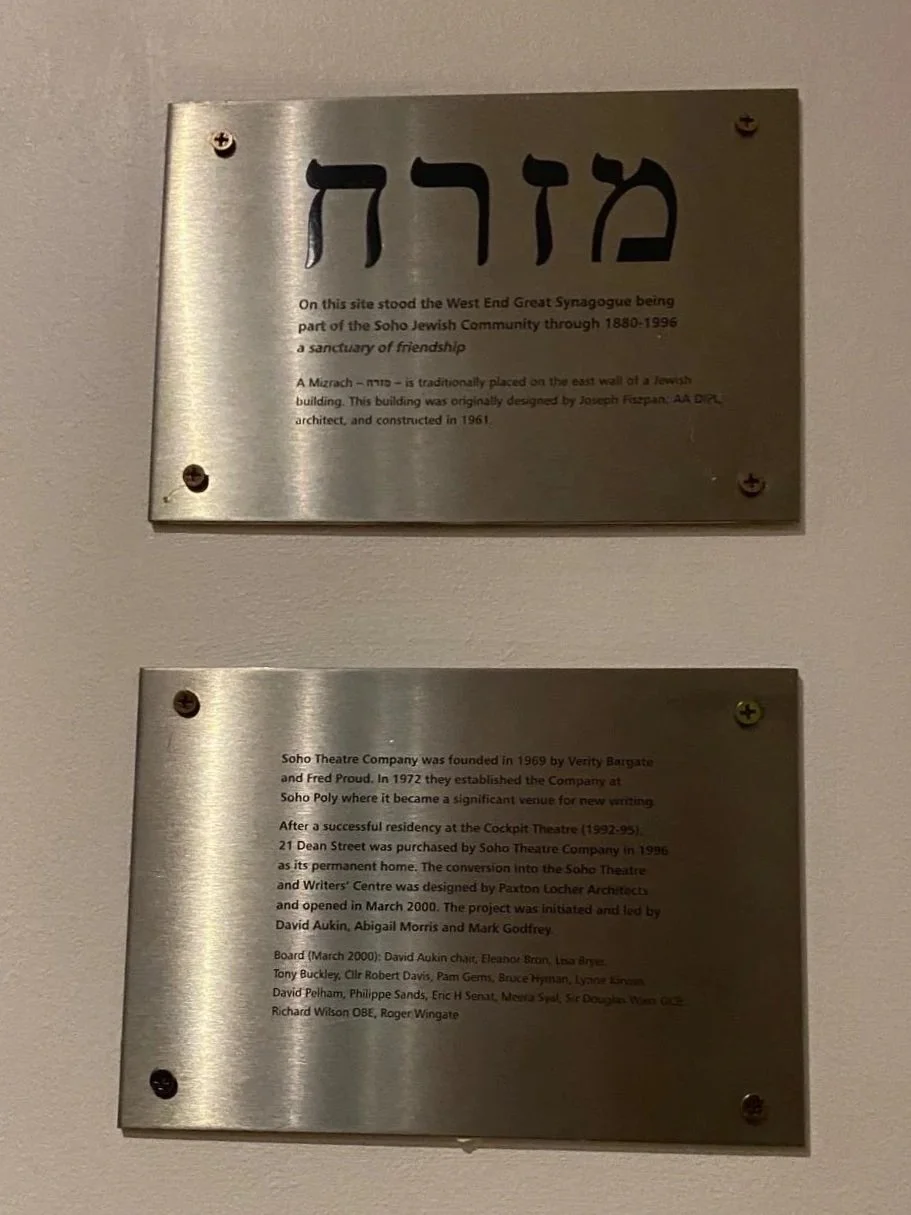
My mum and I shared every plate and we enjoyed every bite, even if we did have to rush eating the chicken (it wouldn’t be a pre-theatre show if you didn’t order the dish that takes the longest to cook despite telling the waiter that you are going to the theatre and you can’t possibly be late). Out of Kapara in the nick of time, we made our way to Soho Theatre to continue our Jewish night in London. Notably, the theatre itself contains some Jewish history; the sign below greeted us as we made our way to our seats.
Before you continue reading, there are many spoiler alerts ahead. You have been warned.
With a run time of 65 minutes, Revenge: After the Levoyah was the epitome of a fringe show. There were only two actors who, rather impressively, played a myriad of characters, ranging from a 94-year-old Holocaust survivor to a northern, liberal rabbi, to a Scottish plumber. The set was stripped back, featuring a table, two chairs, and an industrial shelving unit complete with Mrs Elswood pickles and Palwin’s wine. Other than that, the actors relied on a combination of physical theatre and narration to convey what was happening.
As for the plot, it was quite frankly bizarre, but you can honestly gather that much from the synopsis. The show began with Dan and Lauren’s grandfather, Lenny, smashing his television with a golf club as he’s watching the news channels practically explode with information about Jeremy Corbyn. A dramatic start for sure. We then promptly find out that Lenny passes away that very same night, and the drama dials down as we meet Lauren and Dan at their grandfather’s funeral. Until the drama swiftly re-enters the room, personified as Malcolm Spivak, Lenny’s longtime friend and accomplice, who has no intention of letting his friend’s death bring him down. Oh no. In fact, it has the very opposite effect. He ropes Lauren and Dan into his master plan to kidnap Jeremy Corbyn, a politician infamous for his antisemitism and the cause of many British Jews feeling unsafe and unwelcome in Britain in 2019. After this, nothing highly notable happens in the first half, although Lauren practically kills the Scottish plumber who comes to fix her boiler after she becomes convinced that he is a Nazi. The twins, Dan more so than Lauren, struggle with whether they should assist Malcolm with his plan, but they eventually decide to join him, and things take a turn for the even more satirical.
Along with some more of Malcolm’s trusty accomplice friends, and in what felt like a matter of mere moments, the group succeed in kidnapping Jeremy Corbyn despite a very haphazard plan (I couldn’t tell you what it was, I just remember not feeling convinced, but I guess that’s satire for you). By the way, Jeremy Corbyn is amusingly represented by a stool and never given any lines. They take him to a warehouse and basically hold him hostage. And if you’re pretty certain it can’t get weirder than that, I’m about to prove you wrong. The satire was ramped up to levels I don’t think satire knew it could reach. I’m talking the arrival of Mossad. I’m talking the arrival of the CIA. I’m talking the arrival of MI5 (yes, there were only two actors!). I’m talking helicopters and grenades and guns. I’m talking the arrival of JFJ (Jews for Jeremy). I’m talking fights, and shootings, and a Holocaust survivor faking his own death. The whole last 20 minutes honestly felt like a budget scene from a gangster film and, all in all, I was entertained.
However, beneath the utter whirlwind of chaos were some relatable representations of secular Jewish life. Lauren met her three best friends, Josh, Jake and another J name I can’t remember, on Israel tour when she was 16 (I bet it was FZY!). There are security guards outside their grandfather’s funeral and outside their local shul (shoutout CST). There is a Yiddish word or expression in every other sentence, and a hell of a lot of talk about food.
There are also representations of the devastating impact that antisemitism has on Jewish life. Lauren and Dan’s grandmother refuses to leave her flat for fear of everything going on ‘out there’. Although she should not have killed him, Lauren faced some hostile behaviour from the Scottish plumber after he saw her mezuzah (or, as he called it, a ‘Jew box’) and realised she was Jewish. A Guardian review I read aptly observed that each of the three main characters embodied a different reaction to antisemitism: ‘through passivity (Dan), rising anger (Lauren), or taking direct, violent action (the comically thuggish Malcolm).’
Furthermore, it would be wrong to ignore the obvious political element to this show. The liberal rabbi admitted that, when she criticised Israel in a sermon, she herself was labelled antisemitic by her own congregation. This draws attention to the ongoing debate around antisemitism vs antizionism, raises the question of what even constitutes antizionism (because I, for one, would not class a criticism of the Israeli government’s actions as antizionist), and notes the ongoing problem of Jewish people being shunned by their communities if they openly disagree with Israel’s actions. Moreover, there were even characters, like the rabbi and Dan, questioning whether Jeremy Corbyn is truly antisemitic. My mum and I were uncomfortable with this, but I couldn’t tell if perhaps this was playing into the satire, maybe emphasising Dan’s passive and apathetic nature, or whether the play was genuinely pushing a somewhat sympathetic narrative about Jeremy Corbyn. We still haven’t figured that one out, but it did leave a slightly bad taste in our mouths.
Putting aside these personal qualms, the problems and questions that this play raises are ones that we face as British Jews in 2026, more than ever in the shadow of October 7th. I completely see this show as a type of resistance, a type of answer, a type of method in dealing with antisemitism and navigating Jewish life nowadays. The arts, for me, will always remain the best way for not just human expression, but human unity and connection. I can guarantee you that not everyone in that audience was Jewish, and those who were don’t all believe the same things I do, or have the same Jewish identity that I do. Yet, we all came together for a brief 65 minutes to watch the kidnapping of Jeremy Corbyn. And I recommend that if you get the chance to do the same, you absolutely do.
